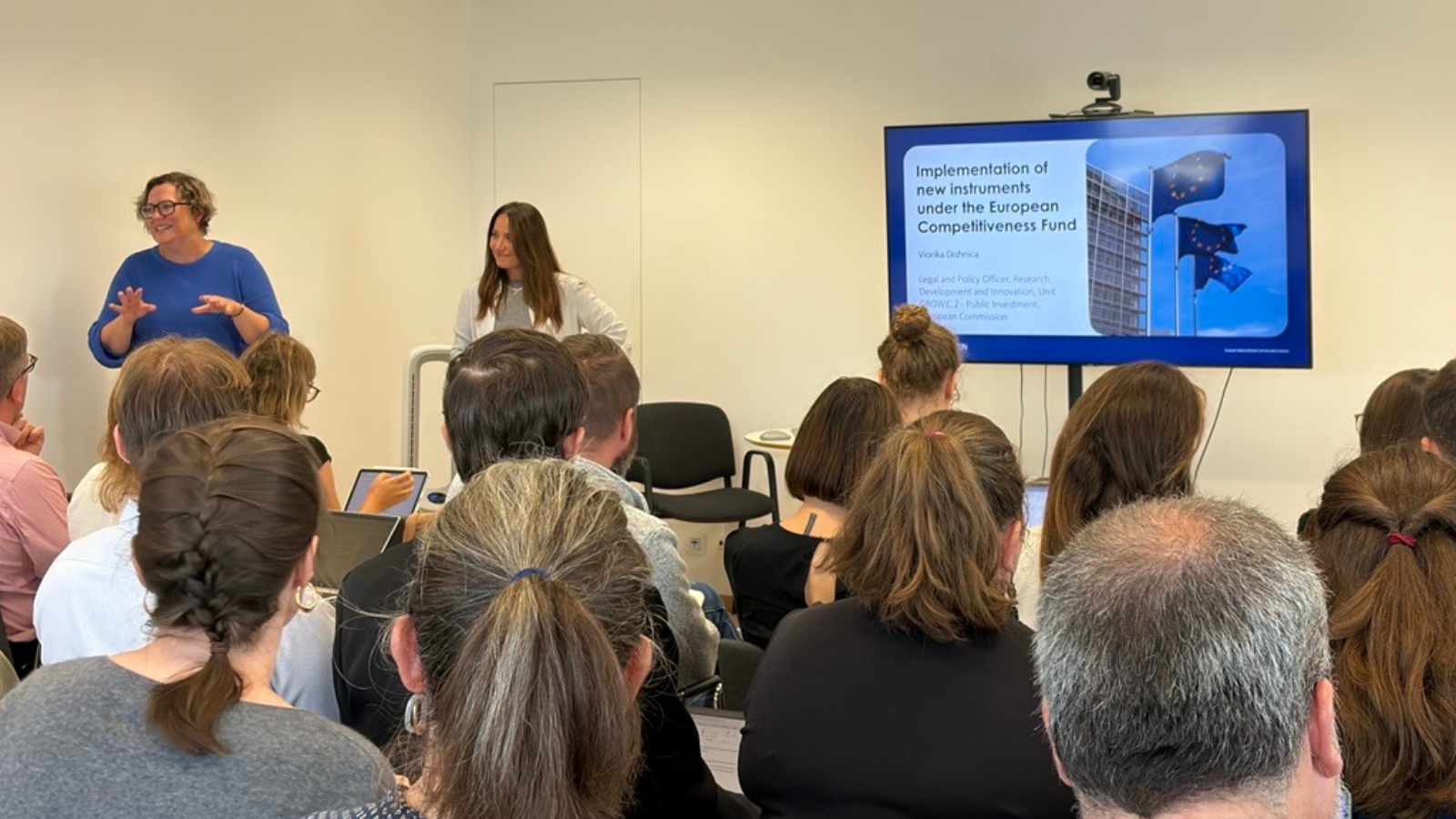
ERRIN Policy Working Group kicks off autumn activities with discussion on the European Competitiveness Fund
With its meeting on 8 September, the ERRIN Policy Working Group kicked off its autumn activities, bringing members together to discuss the latest developments around the future European Competitiveness Fund (ECF) under the next Multiannual Financial Framework (MFF).
The meeting featured an update from Viorika Dishnica, European Commission, DG GROW, on the ongoing discussions around the ECF, followed by an open exchange with ERRIN members. The discussion centred on how the future Fund can be implemented in a way that is simple, agile and effective. A key objective is to simplify the funding landscape for users, while keeping enough flexibility to adapt to changing needs.
A new approach based on the “investment journey”
A central concept presented during the meeting was the investment journey, understood as a continuum of public and private financial and policy support provided to recipients across their entire development chain. The aim is to move away from a narrow project-by-project logic and instead start from planning, prioritisation and the identification of bottlenecks, supported by evidence and data. In this approach, the key question is not only which individual projects need funding, but also what capabilities exist within territories and ecosystems.
The pipeline of projects is expected to emerge from existing or future ecosystems, with the investment journey providing a set of tools that can support projects and initiatives at different stages of development.
The approach should also be sufficiently flexible to accommodate different types of beneficiaries and projects, from single to multiple beneficiaries and from smaller to larger initiatives. The intention is to have the right tool available at the right moment.
Governance and priority-setting
The discussion also looked at how priorities could be identified and translated into future ECF work programmes. The ECF proposal includes a Stakeholder Board, which would have an advisory role in shaping the Fund's long-term priorities and objectives. The Board is expected to bring together representatives from different organisations and areas of expertise. This would be complemented by thematic platforms, which would support more focused, multi-stakeholder consultations and help refine priorities. Multi-annual strategic documents outlined by the Council and the comitology process will be complemented by views and input from stakeholders, helping to inform the identification and refinement of priorities.
Supporting European technology frontrunners and EU value chains
The meeting also explored the proposed EU Tech Frontrunners instrument, which aims to identify and support promising technologies through a dedicated procedure, and the Single Market Value Chains Builder, which aims to bring together suppliers, manufacturers and innovators while contributing to the diversification of sources of supply.
Both the Tech Frontrunners and Value Chains Builder instruments illustrate the broader objective of the ECF: to connect research, innovation, industrial development and investment, while ensuring that different forms of support can be combined along the development journey.
Continuing the dialogue with regions
The meeting provided ERRIN members with an opportunity to discuss the proposed architecture directly with the European Commission and to raise questions about how the new instruments could work in practice.
For ERRIN members, the focus on the capabilities of territories, ecosystems and value chains is particularly relevant. Regions and their innovation ecosystems can play an important role in identifying bottlenecks, connecting stakeholders and ensuring that support reaches initiatives at different stages of their development.
The ECF remains under development and several elements of its implementation will continue to evolve in the coming months. ERRIN and its Policy Working Group will continue to follow these discussions closely, providing input on the proposed instruments and advocating for a funding framework that is responsive to the needs of Europe's regions and innovation ecosystems.