
Regions and Net-Zero Acceleration Valleys: What role can regions play in Europe's clean industrial transition?
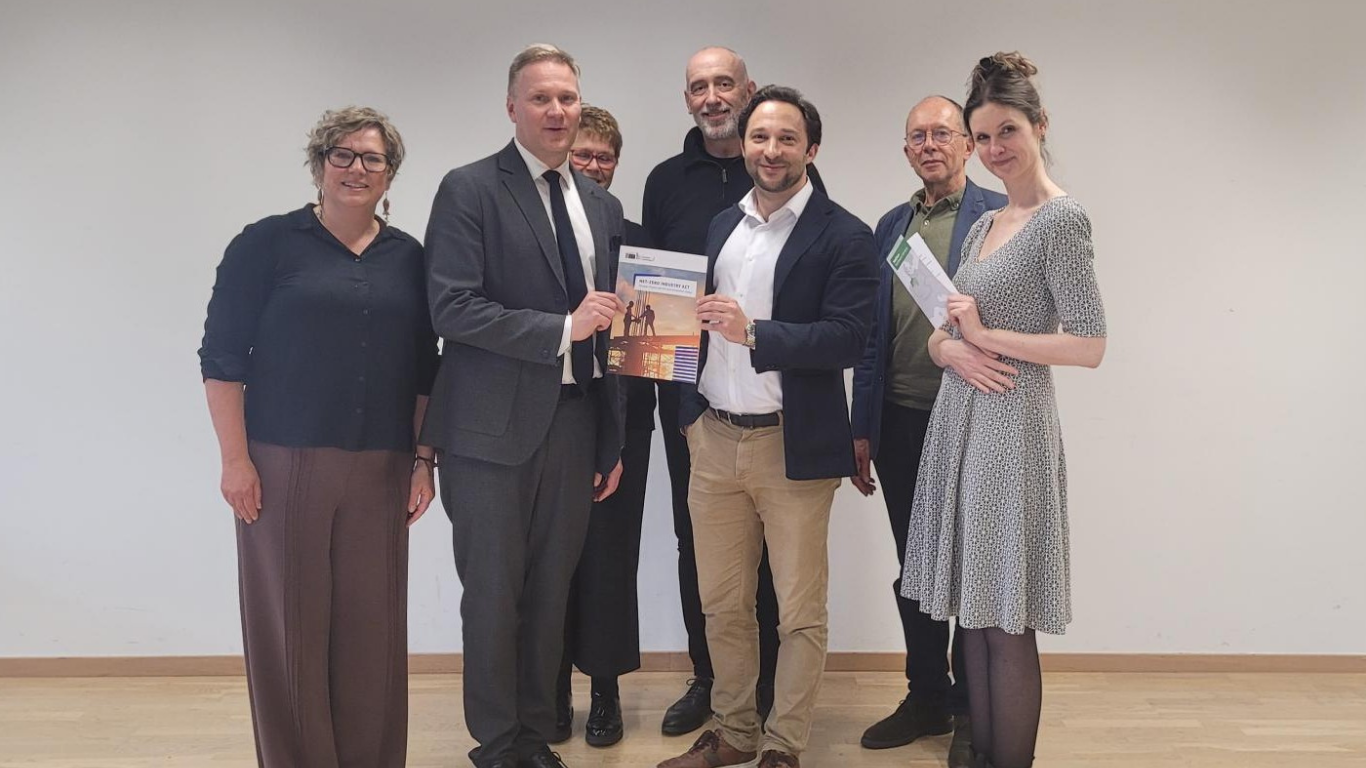
On 5 May, ERRIN and the West Finland European Office hosted a seminar in Brussels bringing together ERRIN members, European Commission representatives and regional practitioners to discuss Net-Zero Acceleration Valleys (NZIA) and industrial competitiveness. The discussion was opened by Mats Brandt, Regional Mayor of Ostrobothnia, who stressed the importance of a whole-of-valleys approach, regulatory sandboxes to enable novel combinations, and better synchronisation between National and Regional Partnership Plans (NRPPs), the European Competitiveness Fund (ECF) and the future Horizon Europe (FP10).
The seminar brought together a variety of different perspectives. From the European Commission, Magdalena Brussel-Jacaszek (DG GROW) covered the regional dimension of the ECF, while Daniel Gerber (DG GROW) focused on Net-Zero Acceleration Valleys and industrial acceleration areas. On the regional side, Hannah Obersteller from the Representation of Lower Saxony presented the NordWest Deutschland Net-Zero Valley, and Birgit Urban and Alexander Ahrens from the Representations of Brandenburg and Saxony shared the experience of the Net-Zero Valley Brandenburg-Saxony. Jan Larosse from Friends of Smart Specialisation rounded off the programme with reflections on Industrial Acceleration Areas and smart specialisation (S3).
Across all contributions, a few themes came up consistently. Regions need to be recognised as real partners in shaping EU instruments, not just implementing them. Net-Zero Acceleration Valleys were seen as a promising tool, and several ERRIN members expressed concrete interest in pursuing valley status. On the ECF, participants were clear that it should explicitly support valleys and help connect them across Europe. ERRIN therefore welcomes the addition in the draft ECF report (from European Parliament) recognising the role of industrial ecosystems and explicitly supporting Net‑Zero Acceleration Valleys and Industrial Acceleration Areas.
Smart Specialisation was also flagged as a natural starting point for interregional collaboration, and cross-border cooperation came up repeatedly as a prerequisite for impact. The seminar also connected participants to the new Net-Zero Acceleration Valleys Network, which brings together emerging valleys across Europe.
These discussions feed directly into ERRIN's ongoing policy work on the future MFF, including our amendments to the ECF and the FP10 proposals. Members interested in exploring Net-Zero Acceleration Valley opportunities are encouraged to contact silvia.ghiretti@errin.eu
- Silvia Ghiretti
- 07/05/2026